
In 2019, I published the Shrimp Insights Guide to the L. vannamei Broodstock Market. In 2022 and 2023, I provided you with an update, but I skipped 2024. So, it is time for the next update. It has been turbulent, with one of the major players filing for bankruptcy, three companies engaged in M&A, and a few others aggressively expanding their operations.
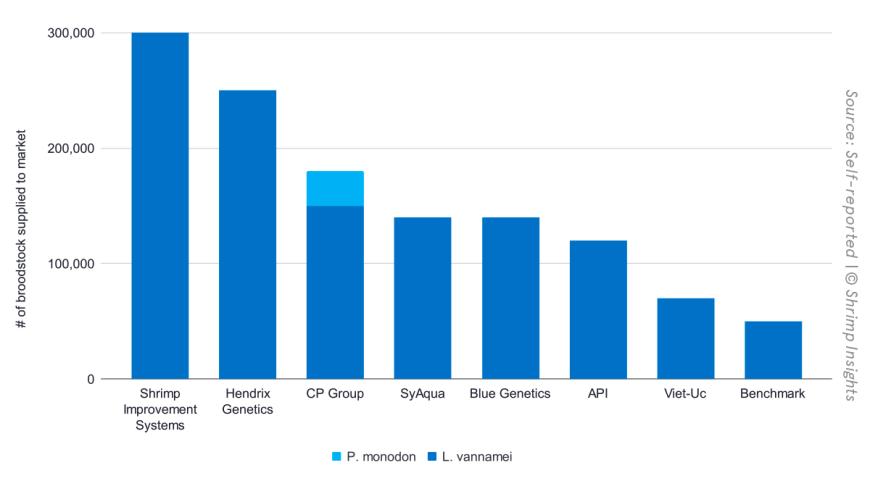
Disclaimer: These numbers have been self-reported by each company except Benchmark and Viet-Uc, for which I made a rough estimate.
While the company names in the top five world broodstock suppliers remain the same, their order has changed, and the list of broodstock suppliers has shortened. The top five in 2024 was led by Shrimp Improvement Systems, followed by Hendrix Genetics, CP Group, SyAqua, and API. Blue Genetics from Mexico and the US, Benchmark Shrimp Genetics from Colombia and the US, and Top Aquaculture from Thailand complement these five companies. Local breeding companies such as Viet Uc in Vietnam, Prima Larvae in Indonesia, and Haid in China are some of the genetics suppliers in Asia.
In this blog, you will find an update on the broodstock market in the world’s most important markets and company updates from the world’s largest broodstock suppliers.
Key Company Observations
- Shrimp Improvement Systems is most likely the world’s largest broodstock supplier, selling around 300,000 in 2024. It is the largest supplier of broodstock to Vietnam and India and has a strong position in Indonesia and China.
- Hendrix Genetics’ BMCs in India, Indonesia, and Thailand are in full swing. As a result, its facility in Hawaii increasingly ships PPL instead of adult broodstock, whereas its facilities in Asia ship adult broodstock to their hatchery clients. Despite a substantial drop in sales to India, the company increased shipments to other countries. It claims to have sold around 250,000 SPF broodstock across the globe in 2024.
- CP Group continues to supply its subsidiaries and customers in South and Southeast Asia from its facilities in Thailand. To reach markets from which its Thai facilities are banned, it is expanding its HomeGrown Shrimp and CP Florida operations in Florida, USA. The company has shipped around 180,000 animals, of which 150,000 were L. vannamei and 30,000 P. monodon.
- SyAqua is the broodstock sector’s fastest-growing supplier, aiming to increase sales from 140,000 in 2024 to 200,000 broodstock in 2025. The company has optimized its operations in Florida and Thailand and acquired US-based Primo Broodstock to expand its capacity further. The company has aggressively gained market share in India and continues to grow its business in China, Indonesia, and other South and Southeast Asian markets.
- Groupe Grimaud, in 2023, after acquiring Sea Products Development and merging its operations with its shrimp genetics division Blue Genetics, has recently made public that it is looking to sell all its shrimp genetics activities. Grimaud aims to sell the company to a strategic investor who can take the company to the next phase of growth. The company claims that in 2024, it supplied 140,000 broodstock to the market, including sales through its BMCs in India and Thailand.
- American Penaeid Inc. went through turmoil due to the impact of two hurricanes on its facilities in 2024. The turmoil led to the short-term departure of its CEO, Robin Pearl, and to filing for bankruptcy. After Robin’s return, the company is motivated to regain market confidence and regrow its broodstock business over the next few years. Its sales in 2024 dropped to 120,000 pieces.
- Benchmark sold its genetics business to Starfish Bidco, a subsidiary of Norway-based Novo Holdings. It’s unclear what the impact of this sale will be on the shrimp genetics division. In late 2024, the company reported breakthrough results in genetic resistance to some significant shrimp diseases. Its sales are thought to be below 50,000 pieces in 2024.
Key Company Observations
- Shrimp Improvement Systems is most likely the world’s largest broodstock supplier, selling around 300,000 in 2024. It is the largest supplier of broodstock to Vietnam and India and has a strong position in Indonesia and China.
- Hendrix Genetics’ BMCs in India, Indonesia, and Thailand are in full swing. As a result, its facility in Hawaii increasingly ships PPL instead of adult broodstock, whereas its facilities in Asia ship adult broodstock to their hatchery clients. Despite a substantial drop in sales to India, the company increased shipments to other countries. It claims to have sold around 250,000 SPF broodstock across the globe in 2024.
- CP Group continues to supply its subsidiaries and customers in South and Southeast Asia from its facilities in Thailand. To reach markets from which its Thai facilities are banned, it is expanding its HomeGrown Shrimp and CP Florida operations in Florida, USA. The company has shipped around 180,000 animals, of which 150,000 were L. vannamei and 30,000 P. monodon.
- SyAqua is the broodstock sector’s fastest-growing supplier, aiming to increase sales from 140,000 in 2024 to 200,000 broodstock in 2025. The company has optimized its operations in Florida and Thailand and acquired US-based Primo Broodstock to expand its capacity further. The company has aggressively gained market share in India and continues to grow its business in China, Indonesia, and other South and Southeast Asian markets.
- Groupe Grimaud, in 2023, after acquiring Sea Products Development and merging its operations with its shrimp genetics division Blue Genetics, has recently made public that it is looking to sell all its shrimp genetics activities. Grimaud aims to sell the company to a strategic investor who can take the company to the next phase of growth. The company claims that in 2024, it supplied 140,000 broodstock to the market, including sales through its BMCs in India and Thailand.
- American Penaeid Inc. went through turmoil due to the impact of two hurricanes on its facilities in 2024. The turmoil led to the short-term departure of its CEO, Robin Pearl, and to filing for bankruptcy. After Robin’s return, the company is motivated to regain market confidence and regrow its broodstock business over the next few years. Its sales in 2024 dropped to 120,000 pieces.
- Benchmark sold its genetics business to Starfish Bidco, a subsidiary of Norway-based Novo Holdings. It’s unclear what the impact of this sale will be on the shrimp genetics division. In late 2024, the company reported breakthrough results in genetic resistance to some significant shrimp diseases. Its sales are thought to be below 50,000 pieces in 2024.
Hendrix Genetics
Hendrix Genetics operates its NBC in Hawaii, selling adult broodstock to hatcheries worldwide and PPL to its BMCs in Indonesia, India, and Thailand. Besides that, it runs a breeding operation in Ecuador. In 2024, across all its operations, the company supplied around 250,000 broodstock to the market, up by around 50,000 compared to 2019, when I published my initial broodstock report.
In 2022, Hendrix Genetics entered a JV with Japfa to establish a BMC in Indonesia. Today, that facility is up and running and can produce around 80,000 broodstock yearly, with the option to expand quickly if needed. According to the company, the demand for broodstock in Indonesia declined by almost 20,000 pieces in 2024. Hendrix Genetics supplied around 70,000 broodstock, which equates to around a 70% share of the total market of 100,000 broodstock. According to the group, while having a JV with Japfa, most of its broodstock clients consist of other hatcheries.
In India, Hendrix Genetics opened its BMC in early 2024. This facility is a JV with Sapthagiri Hatcheries and can produce 160,000 broodstock. The company has been rebuilding market share after, in 2023, it was temporarily banned from the Indian market due to suspicion of the prevalence of pathogens in some of its broodstock. The company states the facility has run exceptionally well since commissioning and initial stocking. First sales commenced in July 2024, and the company’s clients reported excellent performance in the hatchery (which has always been a strong point). Farm performance is mixed. Extremely good in farms with high biosecurity and management practices. Mixed in more challenging farming environments.
As announced in the previous broodstock market update, Hendrix Genetics continues to expand its network of BMCs. The group has set up a BMC in Thailand. This facility was primarily built to expand its capacity to supply China. China remains one of the company’s most important markets, and its shipments to the country continue to grow. Its facility in Malaysia continues to provide the domestic Malay market. Vietnam is the only market in which the company has not significantly grown its business. The company explains that it has been working with selected partners to develop new lines that serve the needs of the Vietnamese market and hopes to grow its market share steadily.
Hendrix Genetics cannot provide further comments on what else is happening. It states that it’s working through some opportunities and has exciting, significant news in the pipeline for 2025, which it can share in the coming months.
SyAqua
In 2022, Ocean 14 Capital acquired a controlling stake in SyAqua from the Golden Springs Group. Today, SyAqua is the world’s fastest-growing broodstock supplier. The company runs NBC and BMC in Florida and Thailand and a BMC in Indonesia. Its facility in Thailand is used to supply the domestic market and other markets in the region that have not banned imports from Thailand, such as China and some other neighboring countries. The facility in the US is used to supply the countries that do not permit import from Thailand, such as India and Indonesia. It is the only broodstock supplier offering its hatchery clients a full range of broodstock and post-larvae diets.
SyAqua has sold approximately 140,000 broodstock in 2024 and aims to sell around 200,000 in 2025. This is up from around 125,000 pieces in 2019 when I published my initial broodstock report. In recent years, SyAqua achieved remarkable growth in Thailand (from zero in 2021 to 18,000 in 2024), Indonesia (from zero in 2022 to 5,000 in 2024), and, most of all, in India (from zero in 2020 to 80,000 in 2024). The only line the company sells, its balanced line, is widely appreciated for its combination of tolerance to disease and growth. In India, the line is especially in high demand due to its perceived high tolerance to common diseases such as EHP, White Feces, and the White Spot Syndrome. The same happens in Indonesia, where farmers struggling with disease try and increasingly choose its balanced line.
In China, Syaqua’s PL is primarily sold to conventional earthen ponds in the southern region with established management experience and technical expertise. Its resistance performance demonstrates superior strength, stability, and yield compared to general fast-growing strains. Additionally, Syaqua is expanding into the greenhouse farming market due to its outstanding resistance against EHP and white feces symptoms. According to the company, in China’s low shrimp price market, Syaqua’s commercial shrimp enables farmers to achieve higher revenues thanks to the high survival rates during live transportation.
While strategically scaling down sales in Thailand, in 2025, the company aims to grow sales in India, Indonesia, China, and Vietnam. The company claims to have one of the best genetics programs in the world and strongly believes in its methods. The company will focus on continuously improving its program and show the positive impact of its genetics on FCR, which, according to the company, is more than 20 points better than its competitors. If its plans materialize, the company will become the world’s largest third-party broodstock supplier by 2026.
Blue Genetics
In 2023, Mexico-based Blue Genetics acquired Sea Products Development in Texas. This acquisition drastically increased the company’s capacity. Today, its operations in Mexico are mainly used to develop its genetics lines (its disease-tolerant Golden Line and its new Sky Line, which has better growth rates). PPL is sent from Mexico to its BMCs in India and Thailand and to its facility in Texas. Its PPL is grown in Texas to adult broodstock and shipped to clients worldwide. In Texas, the company also maintains its fast-growing Texas line. The company now has the flexibility it needs to reach its full potential.
In 2024, Blue Genetics shipped 38,500 PPL from Mexico to its BMC in Thailand and 75,000 PPL to its BMC in India. From Texas, the company shipped XX adult broodstock. Total adult broodstock supplied to hatcheries in 2024 reached 140,000 animals.
The program in Thailand has been slowed down as Chinese customers prefer to receive animals from Texas instead of Thailand due to the poor reputation of Thai broodstock suppliers. About India, Blue Genetics struggled with the performance if its previous genetic lines. One was tolerant to disease but didnt grow fast enough, and the other grew fast but was not sufficiently tolerant to disease. In 2024, Blue Genetics shipped PPL from several lines to fine-tune the best possible genetics for the Indian market. Its new line is now being launched under the commercial name SKY LINE, and PPL and broodstock shipments are being prepared to be on time for the next crop. Blue Genetics expects this new line to regain market share in 2025 and beyond.
Blue Genetics’ biggest market is in China. In 2024, the company shipped over 100,000 adult broodstock of its Golden Line of disease-tolerant animals to its customers in China, especially in the North, where farmers require broodstock that performs well amidst heavy disease pressure. In that market segment, Blue Genetics estimates it market share at around 60%. In the greenhouses in South China, farmers require fast growth lines. Blue Genetics plans to promote its Sky Line to this segment aggressively and expects to sell at least 10,000 broodstock to this market.
Blue Genetics is also selling to other markets. Last year, it entered Iran and sold thousands of broodstock from its Golden Line. In Indonesia, while numbers are still small, the company has launched its Golden and Texas lines and will launch its Sky Line later this year, enabling it to grow its sales. In Vietnam, Blue Genetics is just entering the market, focussing on its Texas line as Vietnamese farmers are focused on fast growth.
In February 2024, Groupe Grimaud, the owner of Blue Genetics, publicly announced that it wanted to sell Blue Genetics. The group’s CEO is about to retire, and without a family successor lined up, he sells his shares to the other company owners. The other company owners have decided to focus the future of the group on its business for land-based animals. As a result, the group is looking to sell Blue Genetics to a strategic investor who can lead Blue Genetics to its next level of growth.
API
American Penaeid Inc. has gone through rough weather in 2024. The company’s facilities in Florida were hit by two hurricanes only three weeks apart. First, Hurricane Helene, while not a direct hit, caused a remarkable amount of damage to its greenhouses, which a tornado may have hit. While picking up the pieces and repairing the facilities, three weeks later, Hurricane Mitch had a direct impact and destroyed all the greenhouse structures, essentially beyond repair. After the storm had passed, the company’s crews were immediately tasked with removing the debris from its tanks and installing individual tank covers, using the usable metal parts from the destroyed greenhouses. Because of its quick action, the company was able to winterize most of its broodstock for the upcoming broodstock season. Robin Pearl, the company’s CEO, expresses his deep appreciation for his crew, who worked tirelessly to protect the animals and ensure operational capabilities were quickly restored.
Pearl resigned shortly after this. But as quick as the CEO left, he also returned. He explains that following the impact of the last two hurricanes, the company needed emergency capital to repair the facilities. A large family shareholder group provided the capital but insisted on taking on a more active role. This quickly transformed his duties from CEO to salesman, and he resigned in November. The shareholder family could not operate the business, and very quickly, it became apparent that his role and skills were significantly more critical than they had imagined. During the nearly 2 months of his absence, they could not follow through on the many opportunities. With the loss of team, sales, and dwindling cash flow, they decided bankruptcy in January was the only way of saving the company. However, within a week from filing, the shareholders and other stakeholders demanded that Pearl return and the family step aside.
Asking Pearl what we should know about how his company will now move ahead, he acknowledges that recent years have been uniquely challenging for the company. First, Covid took the wind out of its growing international business, and then a direct hit of Hurricane Ian in late 2022 caused over $2.5M in damages. API, like most others in the industry suffered through the worst industry slump in 2023 and 2024, and then to top it all off, in late 2024, it was hit by two more hurricanes, which essentially destroyed all its greenhouses – completely writing off the $2.5 million in repairs it had just spent 2 years prior. Then, finally, internal shareholder dissent led to Robin’s resignation and eventual return. He returned because the opportunity for the business to be a major player remains as strong as ever. Pearl claims API has an excellent team, fantastic animals, and a superior location (once climate-resilient upgrades are made), and frankly, the setbacks experienced were out of its control. After some time off and a chance to disconnect and reflect, he claims to have a renewed sense of commitment and, maybe even more importantly, a renewed sense of urgency. He aims to get the company through the re-organization as quickly as possible, then refocus on reclaiming its position as leading broodstock supplier to the world and developing the US domestic shrimp supply.
Despite its challenges at the end of 2024, API shipped approximately 120,000 broodstock in 2024. About 30% to China, about 20% to SE Asia, 25% to South Asia, and 25% to Central and South America. While earlier, it was by far the largest supplier to China, today, it has lost that position. Pearl notes several causes. First, he explains that when the company shipped PPL instead of adult broodstock to China during the COVID-19 pandemic, its customers did not do the culling. Instead of using just the 10% best animals, they would use all the animals as adult broodstock. This was detrimental to the hatchery’s results, and the company’s brand took a heavy hit. Second, API was focused on the hatchery segment supplied to the conventional shrimp farms in North China, which required tolerant and robust animals due to the struggle to perform with widespread disease prevalence. However, China’s production has increasingly shifted to small indoor greenhouses, which are predominantly looking for faster growth lines, which API cannot offer. Third, Pearl reminds us of the long-term lawsuit it has engaged in with a Chinese company. As a result of the lawsuit, his counsel advised Pearl not to travel to China. Now, the ruling has been thrown out by the US Court of Appeals. In November 2024, he traveled to China for the first time in seven years. He visited customers, hatcheries, and farmers whom he had not met in person for a long time.
His recent visit and the progress API is making with the introduction of its Fire Dragon and Golden Dragon Lines make Pearl look forward to and confident about rebuilding API’s market share in China and other markets in Asia and Latin America. The Fire Dragon line includes a trait for a better absorption of astaxanthin, an antioxidant that gives the animals a red color and helps protect them from environmental challenges. The Golden Dragon line grows fast in high-density ponds, better suited for the greenhouse farms in China and more intensive farms in countries such as Vietnam and Indonesia.
Conclusion
We have seen a lot of turbulence in the broodstock supply landscape. M&A activity has led to the change in ownership of Benchmark Shrimp Genetics and Primo Broodstock. Blue Genetics and its sister company, Sea Products Development, are up for sale and will likely change ownership in 2025 or 2026. Moreover, API, still the world’s largest broodstock supplier not too long ago, has filed for bankruptcy and has to regain strength to survive.
Looking at the bigger picture, we slowly see overseas broodstock supply consolidate in a few major groups. Companies such as Hendrix Genetics, CP Group, SyAqua, and Blue Genetics are well-positioned to supply a wide range of markets with their NBCs and BMCs spread between the US and Asia. Shrimp Improvement Systems remains the largest independent broodstock supplier, and while not yet making investments in infrastructure like its competitors, it maintains its market share in most key markets.
In 2025, companies with facilities in the US may face challenges if Trump’s trade war escalates. US suppliers could face retaliatory duties. This is already the case in China, where US suppliers must pay a 15% duty. While some can shift supply to their facilities in Asia, those who don’t have this option are likely to see business with China drop. We have to wait and see how potential tariff wars may impact broodstock trade flows throughout 2025 and beyond, but some impact is expected.
The disturbance of existing trade flows may also accelerate some of the efforts in major shrimp-producing countries to reduce their dependence on overseas broodstock. This trend is most clearly visible in China, Indonesia, and Vietnam, but also in India, this trend may follow suit.
Font: https://www.shrimpinsights.com/blog/2025-update-spf-l-vannamei-broodstock-market